

Jun 13, 2026

Marketing a treatment center has never been simple. But in 2026, the compliance landscape is more layered than ever, and the consequences of getting it wrong have grown significantly more serious. Healthcare marketing regulations now touch every part of how addiction treatment centers advertise, track, and communicate online. From the ads you run to the forms on your website to the way your CRM captures patient data, compliance is not a one-time checkbox. It is an ongoing operational requirement.
This guide covers the compliance frameworks every treatment center marketing team needs to understand, and what each one means for how you market your programs.
LegitScript Certification: The Gateway to Paid Addiction Treatment Marketing
If your treatment center plans to run paid advertising on Google, Meta, or Microsoft Bing, LegitScript certification is not optional. Since 2017, Google has required it as a prerequisite for any addiction treatment advertising. Meta and Bing followed. Without it, your ads will be disapproved and your account flagged, regardless of how legitimate your facility is.
LegitScript evaluates treatment centers on several criteria before certifying them to advertise:
- Valid state licensure to provide addiction treatment services
- Accreditation from a recognized body such as The Joint Commission, CARF, or a state-approved equivalent
- Transparent ownership and operational information
- Compliance with ethical marketing practices, including no patient brokering or deceptive admissions practices
- Disclosure of any affiliate marketing relationships
Certification is not a one-time event. LegitScript conducts ongoing monitoring, and rehab marketing regulations 2026 require certified centers to maintain continuous compliance. A change in ownership, a lapse in licensure, or a marketing practice that crosses compliance lines can result in decertification and immediate loss of advertising access.
According to LegitScript, certification is the required gateway for treatment centers advertising on Google, Meta, Microsoft, and other major platforms. Losing access to those channels is not a minor setback; it can significantly limit a center’s ability to reach prospective patients actively searching for care.
HIPAA and Digital Marketing: Where Most Treatment Centers Unknowingly Slip
HIPAA digital marketing for healthcare is an area where treatment center marketing teams regularly create compliance exposure without realizing it. The issue is not usually intentional. It is structural, built into the way digital marketing tools work by default.
Three areas where HIPAA compliance intersects with digital marketing operations for addiction treatment centers:
- Website tracking pixels and analytics: Standard Google Analytics and Meta Pixel implementations may capture Protected Health Information (PHI) if a user's browsing behavior reveals their health status, which on a treatment center website, it very likely does. The FTC and HHS have both issued guidance on this. HIPAA-compliant analytics configurations, or alternative tracking tools, are now a necessity for treatment center websites.
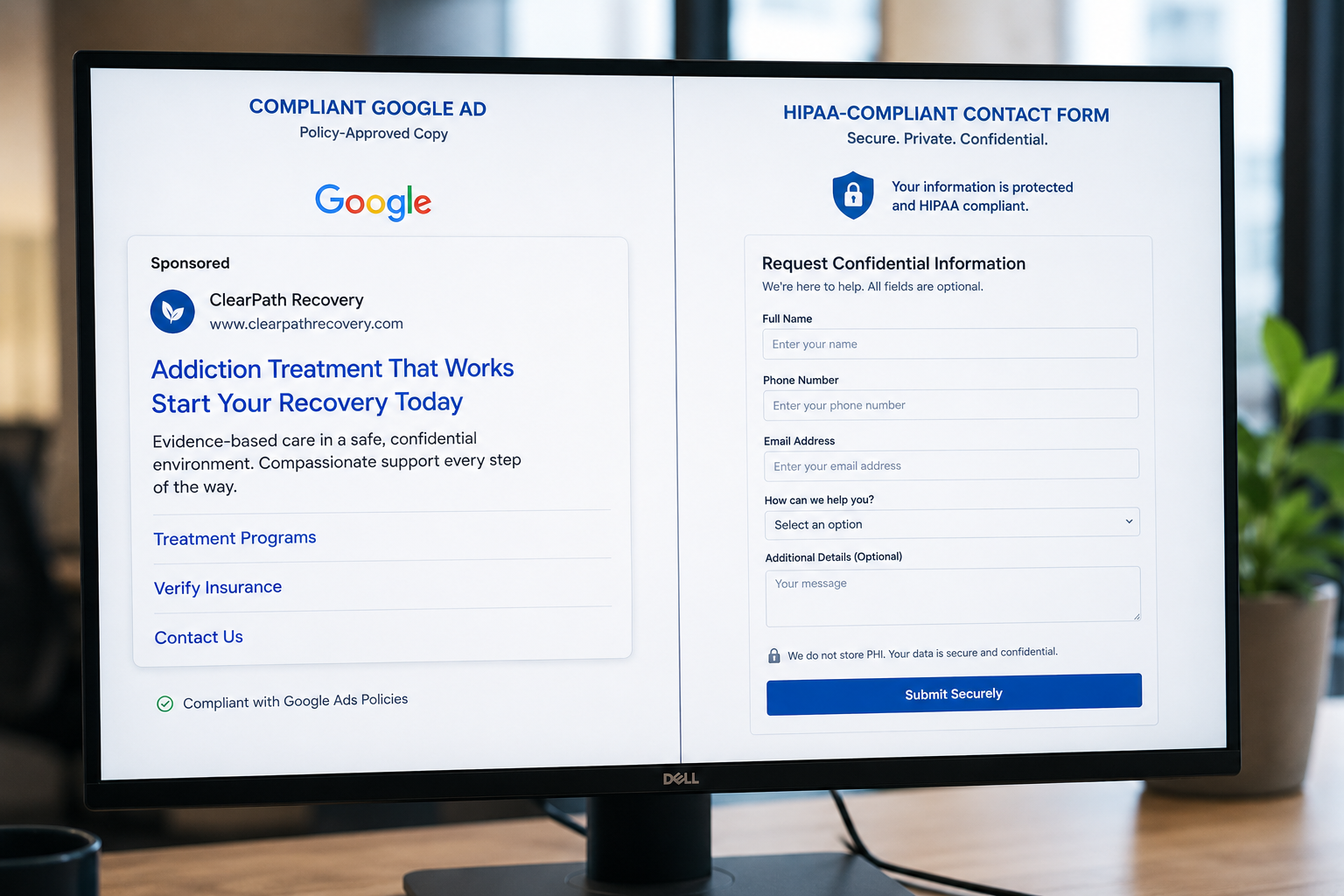
- Contact forms and intake processes: Any form that collects information about a person's health condition or treatment needs must be handled through HIPAA-compliant platforms. Standard web form tools typically do not meet this standard out of the box.
- Email and SMS marketing: Follow-up sequences sent to prospective patients must use HIPAA-compliant communication platforms. Standard email marketing tools like Mailchimp are not HIPAA-compliant without a signed Business Associate Agreement (BAA) and appropriate configuration.
The consequences of non-compliance extend well beyond fines. A HIPAA breach erodes the patient trust that your entire marketing for addiction treatment centers strategy depends on.
Platform-Specific Restrictions for Rehab and Mental Health Marketing Compliance
Beyond LegitScript marketing rules, individual advertising platforms have their own addiction treatment marketing compliance layers that affect how mental health marketing and rehab campaigns can be structured.
Google restricts certain keyword categories, requires specific ad copy standards for healthcare advertisers, and limits the types of landing pages that can be used for clinical services. Meta has significantly curtailed health-based audience targeting, meaning you can no longer target users based on health interests or conditions the way you once could. TikTok and YouTube have their own evolving policies on health-related content.
What this means in practice:
- Ad copy must be accurate, non-sensationalized, and compliant with platform healthcare policies
- Landing pages must not make unsubstantiated outcome claims or use manipulative language
- Retargeting campaigns must be structured carefully to avoid triggering health data privacy restrictions
- Any testimonials or patient stories used in advertising must comply with both platform policies and applicable state and federal regulations
Navigating these platform rules while still building campaigns that generate calls is where working with a specialized digital marketing agency behavioral health team makes a measurable difference. Our PPC marketing services are built around compliance-first campaign architecture, ensuring your ads run without interruption while still delivering results.
The FTC and Truth-in-Advertising Rules for Rehab Marketing
The Federal Trade Commission's truth-in-advertising standards apply to treatment center marketing just as they apply to any other industry. But in healthcare, the stakes of deceptive claims are higher, and the FTC has increasingly turned its attention to behavioral health marketing.
Claims about treatment outcomes, success rates, or patient experiences must be substantiated. Testimonials must reflect genuine patient experiences and include appropriate disclosures. "Best," "leading," and "most effective" superlatives require evidence to support them.
Common rehab centers marketing compliance violations that treatment centers should audit for:
- Unsubstantiated success rate claims, such as specific percentage recovery rates without clinical data
- Testimonials that do not represent typical patient outcomes without appropriate disclaimers
- Misleading geographic or program descriptions that imply services or locations that do not exist
- Any content that creates a false sense of exclusivity, urgency, or guaranteed outcomes
Building a Compliance-First Marketing Culture
The most sustainable approach to healthcare marketing compliance is not reactive, catching problems after they arise. It is building compliance into your marketing process from the start.
That means regular audits of your website tracking setup, advertising accounts, email platforms, and CRM configurations. It means a content review process that checks claims before publication. It means training for anyone on your team who touches marketing materials.
And it means working with partners who understand the regulatory environment you operate in. A general digital marketing agency may not know what a BAA is, or how to configure a HIPAA-compliant pixel. A specialized behavioral health partner does.
For context on what compliant, high-performing treatment center marketing looks like in practice, see how we approached the full digital strategy for Lotus Recovery SC, building a presence that is both effective and compliant from the ground up.
Compliance Is Not a Barrier to Growth. It Is the Foundation of It.
RxMedia builds addiction treatment healthcare marketing strategies that are compliant by design, not as an afterthought. From LegitScript-ready ad architecture to HIPAA digital marketing healthcare tracking configurations, we handle the complexity so your marketing performs without putting your center at risk.
Book your free compliance and marketing review, and make sure your 2026 strategy is built on solid ground.