
Jun 6, 2026

Most treatment centers have invested in marketing for addiction treatment centers. They have a website, run some ads, and maybe publish content regularly. And yet, somewhere between the first inquiry and the admission, leads disappear. Calls go untracked. Follow-ups fall through the cracks. No one can say with certainty where a patient first found the center.
The problem is rarely the marketing itself. It's the infrastructure behind it. And for most treatment centers, that infrastructure gap comes down to one thing: a disconnected CRM and EMR.
Fixing that connection is one of the highest-leverage improvements you can make to your marketing systems because it closes operational gaps that quietly cost admissions every day. In this blog, we’ll break down how disconnected CRM and EMR systems create leaks in the admissions pipeline, what true integration looks like in practice, and why connected infrastructure is essential for stronger marketing performance and measurable growth.
The Admissions Pipeline Problem Most Treatment Centers Don't See
Here's a scenario that plays out in treatment centers every day. A prospective patient fills out a contact form after finding the center through a Google search. The inquiry lands in an inbox. Someone follows up, but not until the next morning. By then, the person had called two other centers. They admit somewhere else.
No one flagged the delay. No one knew the lead came from paid search versus organic. No one triggered an automatic follow-up text within five minutes of the form submission. And no data was captured to inform future marketing decisions.
This is what a broken admissions pipeline looks like. It's not dramatic, it's just slow and leaky. And it costs treatment centers far more in lost admissions than most realize.
What CRM Integration Actually Does for Addiction Treatment Marketing
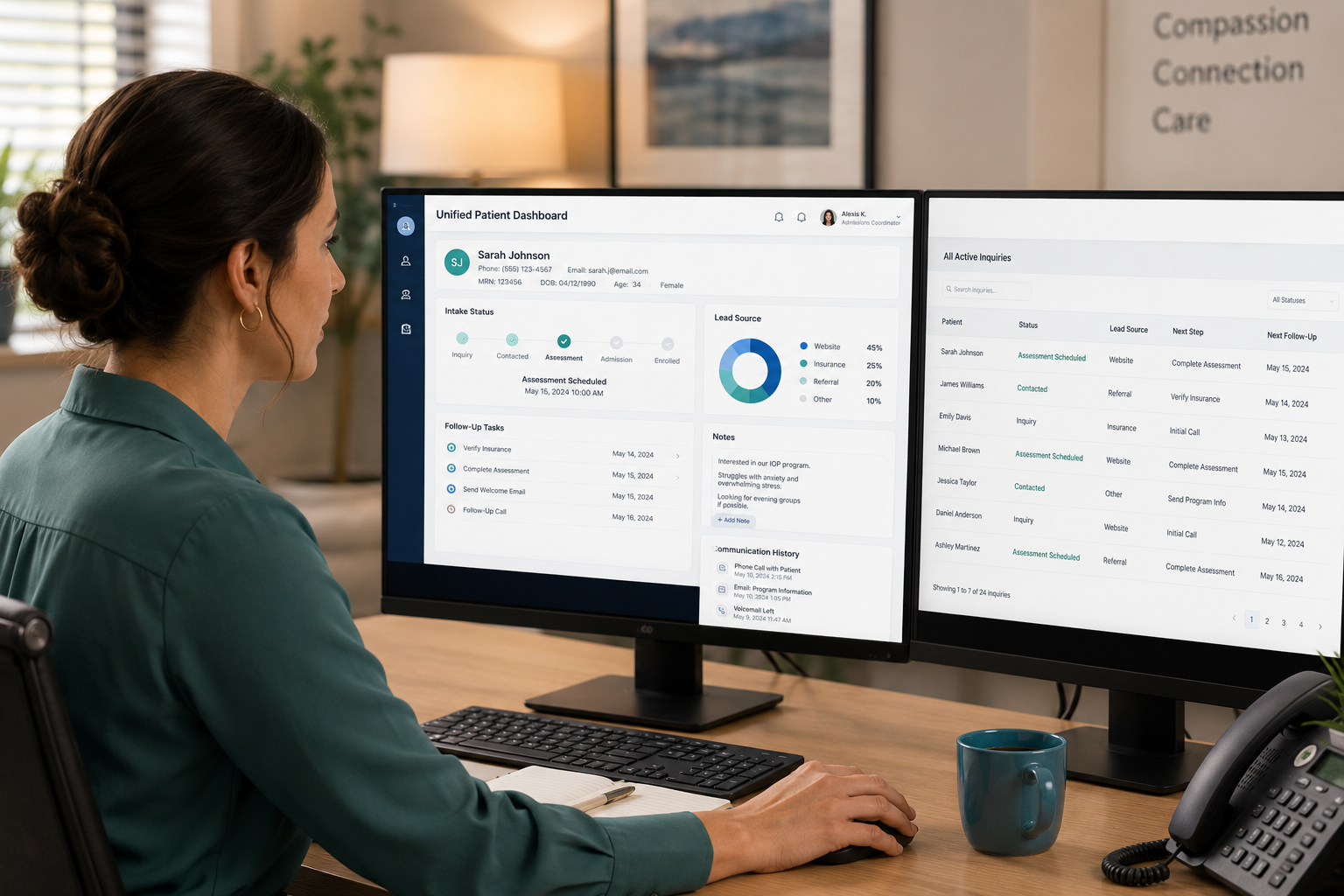
A CRM (Customer Relationship Management) system, when properly configured for rehab marketing, does three things that transform your admissions pipeline. It captures every lead from every channel in one place. It automates the follow-up so no inquiry goes cold. And it tracks the full journey from first contact to admission so you know exactly what your marketing is producing.
For marketing for addiction treatment centers specifically, CRM integration enables:
- Instant lead response: Automated SMS and email follow-up within minutes of a form submission or missed call, dramatically increasing contact rates before a prospect calls a competitor.
- Lead source attribution: Every inquiry tagged with its originating channel, whether that is organic search, Google Ads, a referral, or a social campaign, so budget decisions are based on real data.
- Pipeline visibility: A clear view of how many leads are at each stage, which are stalled, and where the drop-offs are happening, so your team can intervene at the right moment.
- Referral relationship management: Tracking which physicians, therapists, and community organizations are sending referrals, and managing outreach to those relationships systematically.
This is precisely the infrastructure that separates high-performing treatment centers from those that are flying blind. Our CRM and EMR management services are built around platforms like GoHighLevel, configured specifically for the behavioral health admissions workflow.
Where EMR Integration Completes the Picture
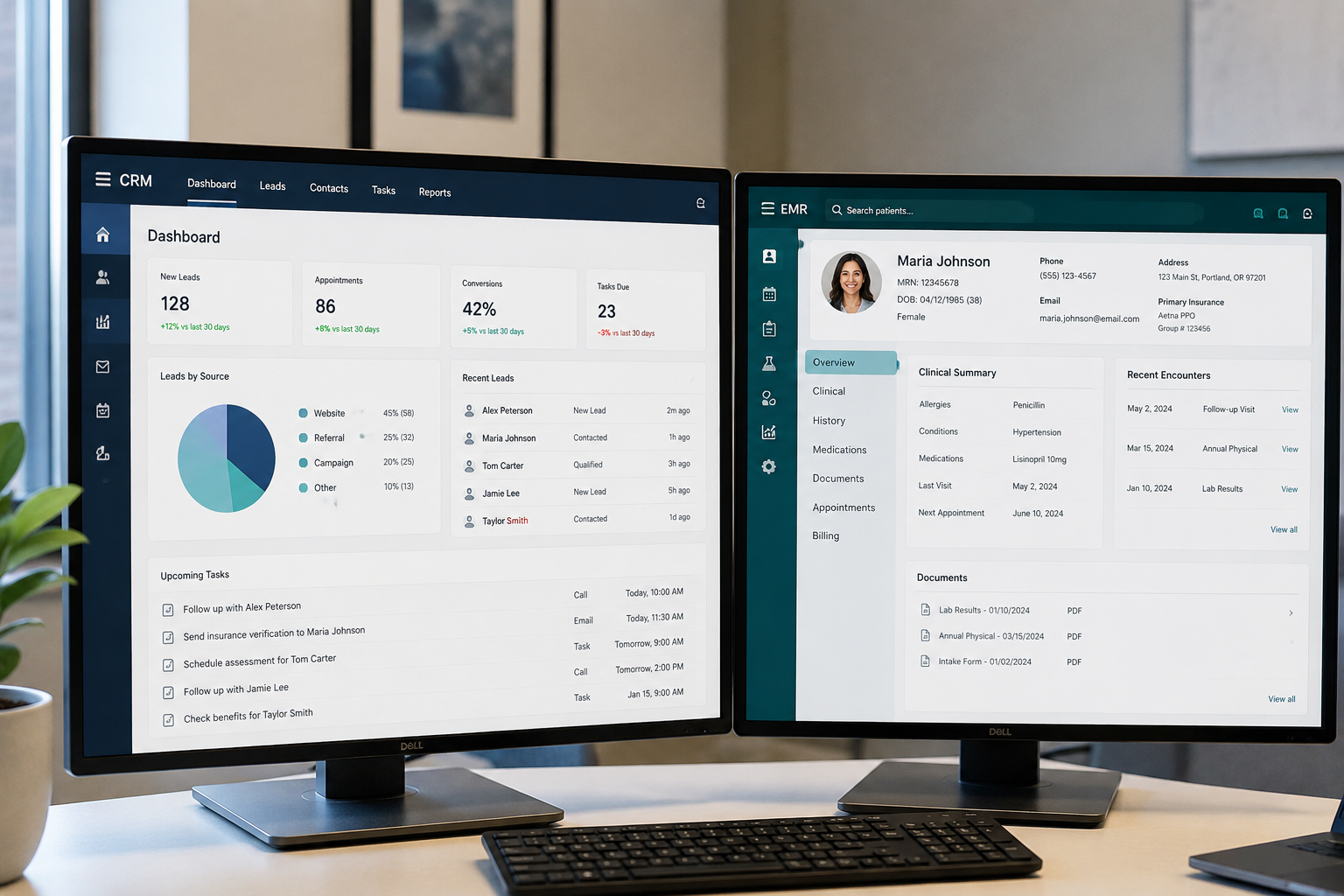
CRM for rehab centers manages the marketing and admissions side. EMR (Electronic Medical Records) manages the clinical side. When these two systems don't communicate, treatment centers end up with a fundamental operational gap: the moment a prospect becomes a patient, they essentially disappear from the marketing system.
That gap has real consequences for addiction treatment marketing and healthcare marketing operations:
- You cannot accurately calculate patient acquisition cost without knowing which admitted patients came from which marketing channels.
- You cannot optimize your marketing budget without connecting admission outcomes to campaign performance.
- You cannot build effective alumni outreach or re-engagement campaigns without access to structured discharge data.
When CRM and EMR are integrated, or at minimum synchronized through a structured data handoff, the full loop closes. Marketing investment connects to clinical outcomes. Lead data connects to patient records. And your rehab marketing strategy becomes something you can actually measure end to end.
This is where EMR integration marketing behavioral health strategies become essential. Connected systems do more than improve reporting. They create a measurable, end-to-end admissions and care workflow that supports smarter decisions, stronger attribution, and more sustainable growth.
The Digital Marketing Agency Advantage
Most general marketing agencies have never configured a CRM for a treatment center admissions workflow. They don't know what a warm transfer is, how to build a HIPAA-compliant intake form, or how to structure automation sequences that respect the sensitivity of a behavioral health inquiry.
A digital marketing agency behavioral health specialists understand that the CRM isn't just a sales tool. It's a care coordination tool. The automation sequences they build aren't aggressive sales funnels. They're empathetic, timed follow-ups that meet a person in crisis where they are and make it easy to take the next step.
The difference in how those sequences are written, timed, and structured determines whether a cold lead becomes an admission or a missed opportunity.
Building a System That Feeds Itself
The most powerful outcome of a fully integrated CRM and EMR setup for rehab centers marketing is the feedback loop it creates. Every campaign generates data. That data informs the next campaign. Over time, you stop guessing about what drives admissions and start knowing.
You know that organic search leads convert at a higher rate than paid leads, but paid leads move faster. You know that referrals from a specific hospital network have a 70% higher admission rate than cold form fills. You know that a second follow-up text sent 48 hours after no response re-engages one in five leads.
This is what mature, data-driven marketing for addiction treatment centers looks like. And it all starts with the right infrastructure.
See how this plays out in practice in our Atlas Treatment Center case study, where an integrated CRM and content strategy helped a brand-new center build a high-performing admissions pipeline from day one.
Centers like Atlas Treatment Center demonstrate what becomes possible when marketing infrastructure and clinical operations are built to work together from the start, not patched together after the fact.
Stop Losing Leads You Already Paid to Generate
RxMedia builds and manages CRM systems configured specifically for addiction treatment and behavioral health admissions workflows. From lead capture to attribution to automated follow-up, we connect every piece of your pipeline so nothing falls through the cracks.
Effective marketing for addiction treatment centers depends on more than visibility. It depends on having the right infrastructure in place to track, respond to, and convert every opportunity.
Schedule your free pipeline audit today!
.png)