How AI Search Is Changing How People Find Addiction Treatment
AI search is reshaping how patients find addiction treatment. Learn the risks of AI invisibility and how treatment centers can earn AI citations.
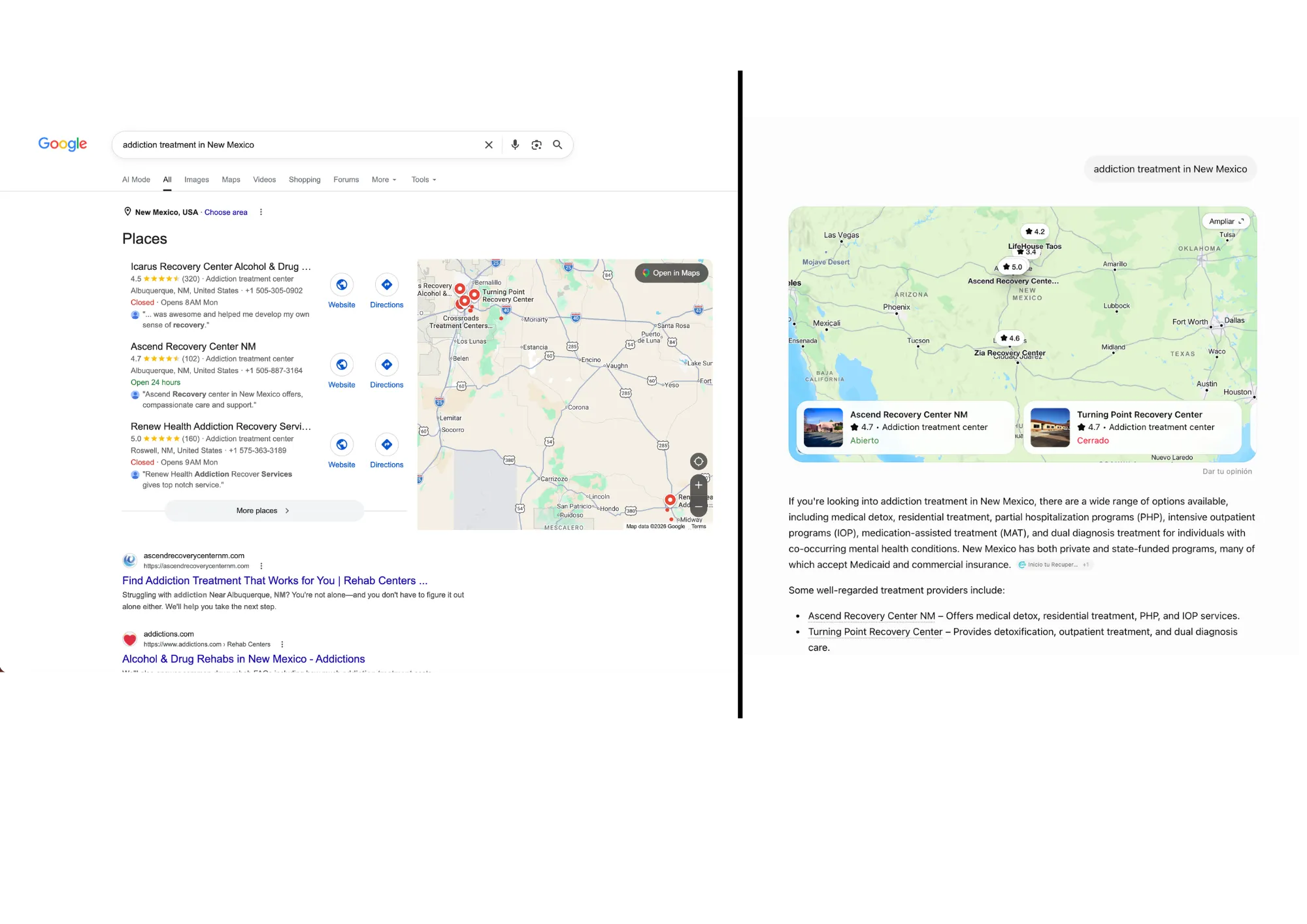
A family member searching for help at 2am used to type “addiction treatment near me” into Google and scroll through ten blue links. Now they open ChatGPT and ask, “what’s the best inpatient rehab for someone with both PTSD and alcohol use disorder?” The AI answers directly, names three to five programs, and the family calls one of them. Google never enters the picture.
This shift is already measurable in behavioral health search data, and it changes what “getting found” means for treatment centers, whether that means local rankings, organic rankings, or the newer AI-driven search layered on top of both.
The scale of who’s searching makes this hard to ignore. In 2023, an estimated 48.5 million people aged 12 or older (17.1% of the U.S. population) had a substance use disorder in the past year, according to SAMHSA’s National Survey on Drug Use and Health. Every one of them, or a family member acting on their behalf, is a potential searcher, and a growing share of that searching now happens inside an AI conversation instead of a Google results page.
Patient behavior has changed, and the stakes are higher
Traditional search rewarded a good guess at what someone might type. AI search rewards being the answer to what someone actually asked. Patients and families now pose full questions to ChatGPT, Perplexity, and Google’s AI Overviews: which programs take their insurance, which ones treat dual diagnosis, what detox actually involves, what the difference is between PHP and IOP. The AI engine reads across the web, picks three to five sources it trusts, and presents a synthesized answer with citations. A prospective patient’s shortlist gets built before they ever land on a treatment center’s website. Ranking #1 in classic Google results no longer guarantees a place in that answer; it’s a separate, parallel competition with its own rules.
For most industries, missing that shortlist means missing some traffic. For addiction treatment, it means missing the moment someone was ready to call, for two reasons specific to this vertical.
The search often happens in crisis, not research mode. Someone asking an AI assistant about detox options at 2am isn’t going to run five more searches to double-check. Whoever gets cited gets the call.
Families research for weeks, then ask AI to validate the shortlist. After days of comparing programs on their own, families often turn to AI to summarize what they’ve found and confirm what’s trustworthy. If a center’s content never made it into that synthesis, it’s invisible at the exact moment of decision, regardless of how strong its actual care is.
RxMedia’s addiction treatment clients are already dealing with both patterns. Treatment centers already write for two audiences: the person in crisis and the family doing due diligence. AI search adds a third layer, an AI system deciding which of those two audiences’ content is trustworthy enough to cite.
Consumer trust is already shifting toward these AI-mediated answers. In BrightLocal’s 2026 Local Consumer Review Survey, 40% of consumers said they trust AI platforms to provide business recommendations, 42% said they trust AI recommendations as much as traditional reviews, and 82% said they read AI-generated review summaries, with 23% willing to rely on those summaries alone. For a decision as high-stakes as choosing a treatment provider, that’s a meaningful share of the audience letting an AI system pre-filter their options before they ever compare centers themselves.
AI engines don’t reward what Google used to reward
This is the part most agencies still get wrong. Ranking signals from 2015 (keyword density, backlink volume, exact-match domains) don’t carry the same weight with LLM-based answer engines. What does:
- Answer-first structure. The first two or three sentences under a heading need to directly answer the question the heading poses. AI extractors pull that text as a citation; buried answers don’t get quoted.
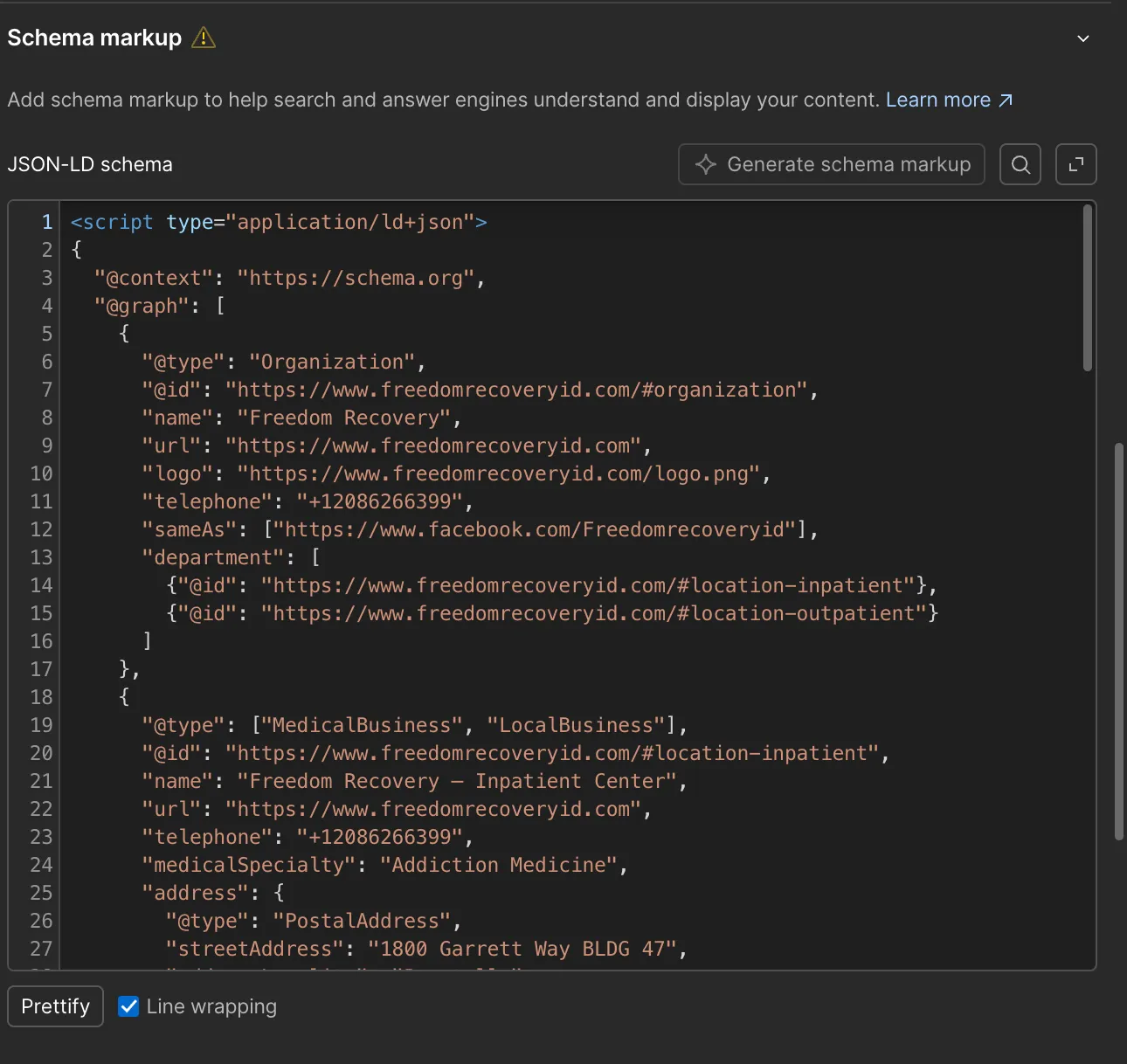
- Structured data. Schema markup (MedicalCondition, MedicalProcedure, FAQPage, Organization) tells an AI engine what a page actually means, rather than leaving it to infer.
- Topical authority. A domain that covers a condition or treatment modality in real depth (pillar pages plus supporting clusters) reads as more authoritative than a single well-optimized page.
- Verified E-E-A-T signals. For addiction treatment, a Your-Money-Your-Life (YMYL) category, AI engines lean hard on clinician credentials, medical reviewer attribution, and cited sources. A generic “our team” bio doesn’t clear that bar; a licensed clinician’s name, credentials, and years of practice does.
- Off-site entity presence. Directories AI engines actually pull from (SAMHSA’s treatment locator, Recovery.com, professional licensing boards) matter as much as anything on the treatment center’s own site.
What this looks like in practice
When ChatGPT and Perplexity are asked about treatment options, they cite sources they trust for medical accuracy. That’s exactly the lane Cielo Treatment Center, one of RxMedia’s addiction treatment clients, already occupies: its content shows up as a cited source in AI-generated answers alongside samhsa.gov and insurer sites like aetna.com. That’s the target outcome, not ranking near authoritative healthcare sources, but being named next to them. This work, AI SEO, is a distinct discipline from traditional search optimization, even though the two work together.
Getting there follows a specific process, not a guess. Audit which queries currently trigger AI Overviews or AI engine answers in a center’s market and who’s cited today. Rebuild the highest-intent pages to lead with direct answers instead of preamble. Implement medical schema markup and named, credentialed clinician bios as part of an ongoing content strategy rather than a one-time project. Build out topical depth across pillar and cluster content rather than scattered one-off pages. Establish off-site entity presence in the directories AI engines actually pull from. Then monitor monthly, since citation patterns shift as competitors catch up.
What treatment centers can do now
- Audit your current AI visibility. Ask ChatGPT and Perplexity the questions your prospective patients are asking (insurance-specific, condition-specific, city-specific) and see who gets cited. If it isn’t you, that’s the gap to close first.
- Rewrite your highest-intent pages to answer first. Cut the preamble. Lead each section with the direct answer, then support it.
- Add clinician-verified content signals. Named clinicians, credentials, and a medical reviewer note on treatment-related pages, not an anonymous “clinical team.”
- Implement medical schema markup. MedicalCondition, MedicalProcedure, and FAQPage schema across service pages, plus Organization schema sitewide.
- Build topical depth, not scattered pages. Group content into pillars (e.g., detox, PHP, IOP, dual diagnosis) with cluster articles underneath each.
- Get listed where AI engines actually look. SAMHSA’s locator, Recovery.com, and healthcare-specific directories carry more weight with AI systems than general business listings do.
- Monitor, don’t guess. Track which queries trigger AI Overviews in your market and who’s currently cited, then measure movement monthly through attribution reporting tied to actual admissions, not just clicks.
Conclusion
The centers that show up in AI-generated answers today are the ones that treated this as a distinct discipline from traditional SEO: structured data, verified credentials, and answer-first content, not just more blog posts. The patients and families asking AI these questions right now are making their shortlist in real time. Getting into that shortlist starts with knowing exactly where you stand.
Ready to see where your practice stands? Book a free AI visibility audit — we’ll check ChatGPT, Perplexity, and Google AI Overviews for your practice’s core queries and show you who’s getting cited instead of you.
Frequently asked
Is AI search actually replacing Google for addiction treatment searches?
Not replacing it outright, but intercepting a growing share of it. Google's own AI Overviews now answer many queries before a user reaches the organic results, and standalone tools like ChatGPT and Perplexity capture searches that never touch Google at all.
Does strong traditional SEO automatically mean strong AI visibility?
No. A center can rank #1 organically for its core local terms and still have zero presence in AI-generated answers, because AI engines weight structured data, verified clinician credentials, and answer-first formatting — signals that classic keyword-and-backlink SEO doesn't require. The two are related disciplines, not the same optimization target.
What's the fastest way to see if my center is losing ground here?
Ask ChatGPT, Perplexity, and Google directly the questions a prospective patient or family would ask about your specialty and city, and note who gets cited. RxMedia's free AI visibility audit runs this check and returns a prioritized fix list in about 20 seconds.
Do E-E-A-T signals really matter that much for addiction treatment content?
Yes, more than most verticals. Addiction treatment sits squarely in Google's and AI engines' 'Your Money or Your Life' category, where verified clinical credentials and cited sources carry disproportionate weight in what gets trusted and cited.
Can a smaller, single-location treatment center compete for AI citations against larger providers?
Yes. AI citation rates are driven by content depth and verified authority signals, not domain size or ad spend, which is a more level playing field than the paid-search competition most centers are used to.