The Most Common Local SEO Mistakes Addiction Treatment Centers Make (And How to Avoid Them)
The local SEO mistakes costing addiction treatment centers calls and admissions (GBP, NAP, reviews, location pages) and how to fix each one.
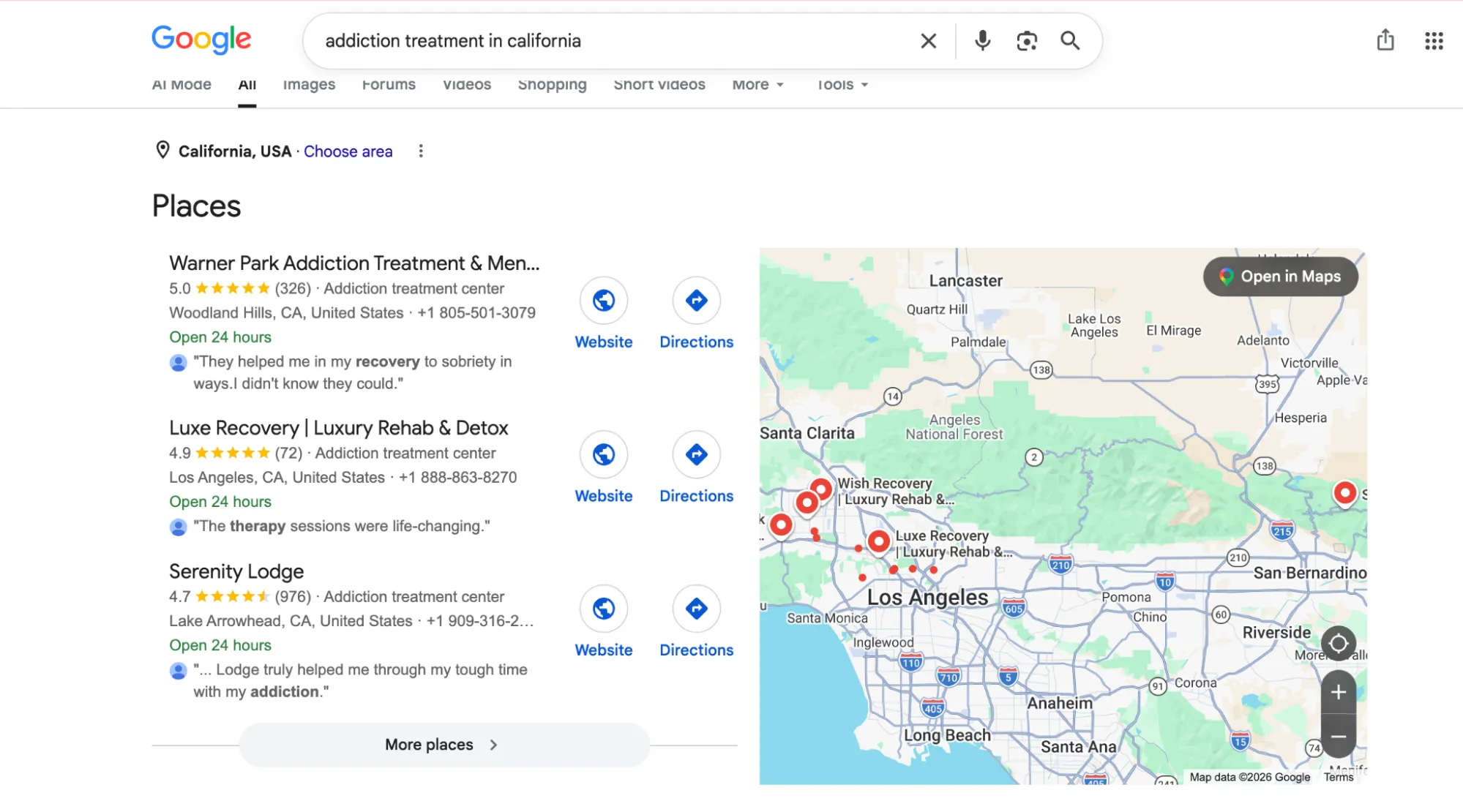
Most people looking for addiction treatment search locally. They type things like “rehab near me,” “detox in Portland,” or “IOP that takes Aetna.” When they do, Google usually shows Google Business Profiles and local search results before traditional website listings.
That’s because addiction treatment requires proximity. IOP means showing up three to five days a week; residential care means showing up daily. Patients need a program they can actually get to, so every search is tied to a specific city or zip code from the start.
Most of the centers we audit are losing calls to the same handful of fixable mistakes in that local search experience. Here they are, in order of how often we see them.
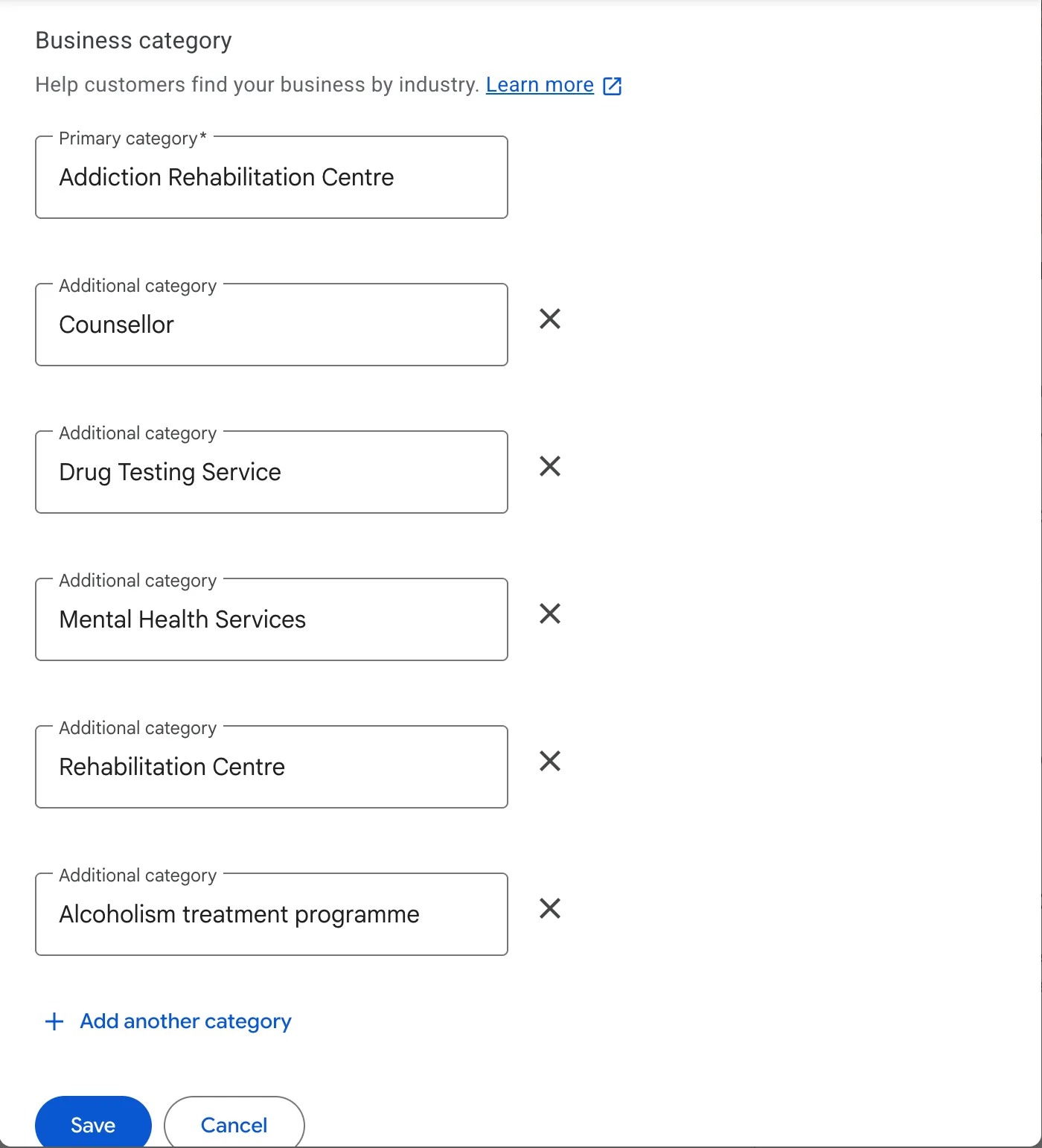
Mistake 1: Choosing the wrong Google Business Profile category
“Addiction Treatment Center,” “Drug Addiction Treatment Center,” and “Alcohol Treatment Center” are different GBP categories that surface for different searches. Centers routinely pick one generic category and leave it there indefinitely, even when their program mix (detox, PHP, IOP, outpatient) would justify a more precise primary category and several accurate secondary ones.
The fix: Match your GBP categories to the specific services and levels of care you actually offer, and revisit them whenever your program mix changes. This is one of the highest-leverage local moves available, and it costs nothing but attention.
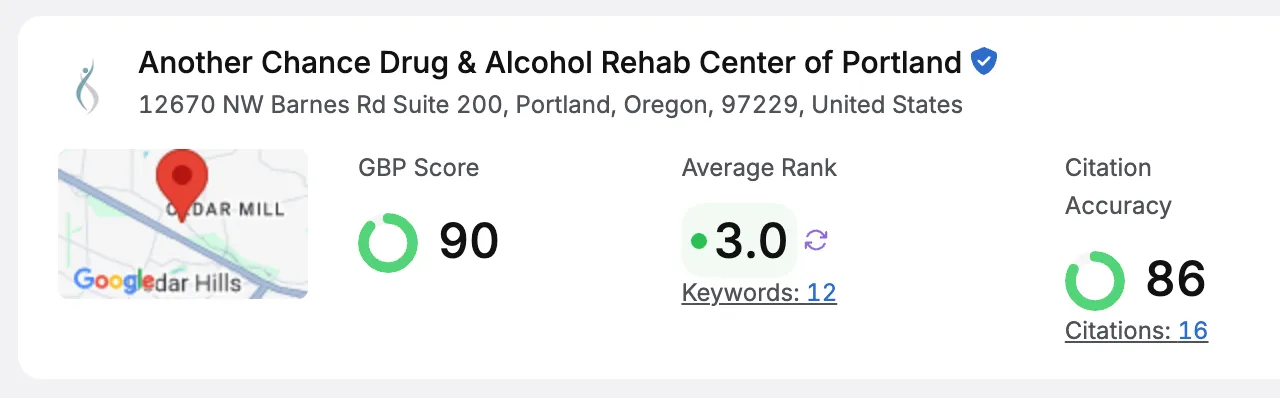
Mistake 2: Inconsistent business information (NAP) across the web
Name, address, and phone number look like a formality until they’re wrong on a directory a prospective patient’s family checked. Old addresses from a relocated clinic, a phone number that was reassigned to a new department, a business name that’s “Recovery Center” on one listing and “Recovery Center, LLC” on another: each inconsistency is a small trust signal that something isn’t well-maintained, and a larger technical signal to Google that it isn’t sure which listing is authoritative.
The fix: Audit every listing (healthcare directories, general business directories, insurance directories, review sites) and correct every variation. This isn’t a one-time project; it needs a recheck every time a location, number, or name detail changes.
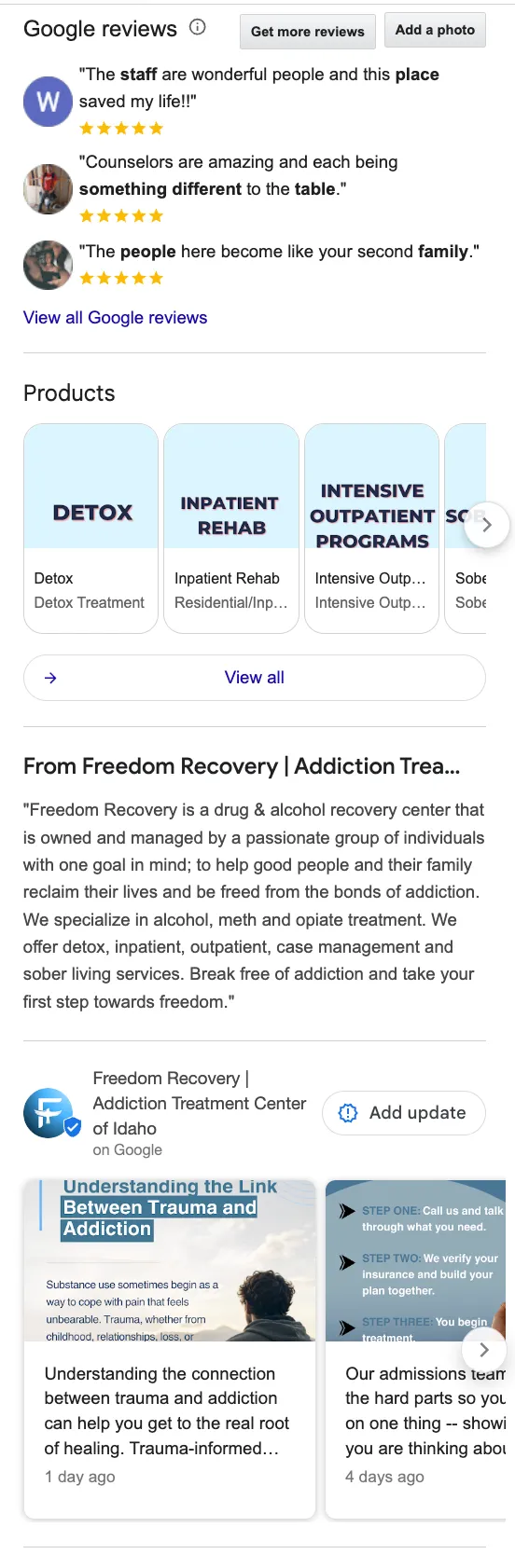
Mistake 3: A neglected Google Business Profile
A claimed-but-abandoned GBP is nearly as damaging as an unclaimed one. Missing photos, no posts in the last year, incomplete service and attribute fields, unanswered Q&A: every gap is a place a competitor’s more complete profile wins the click instead.
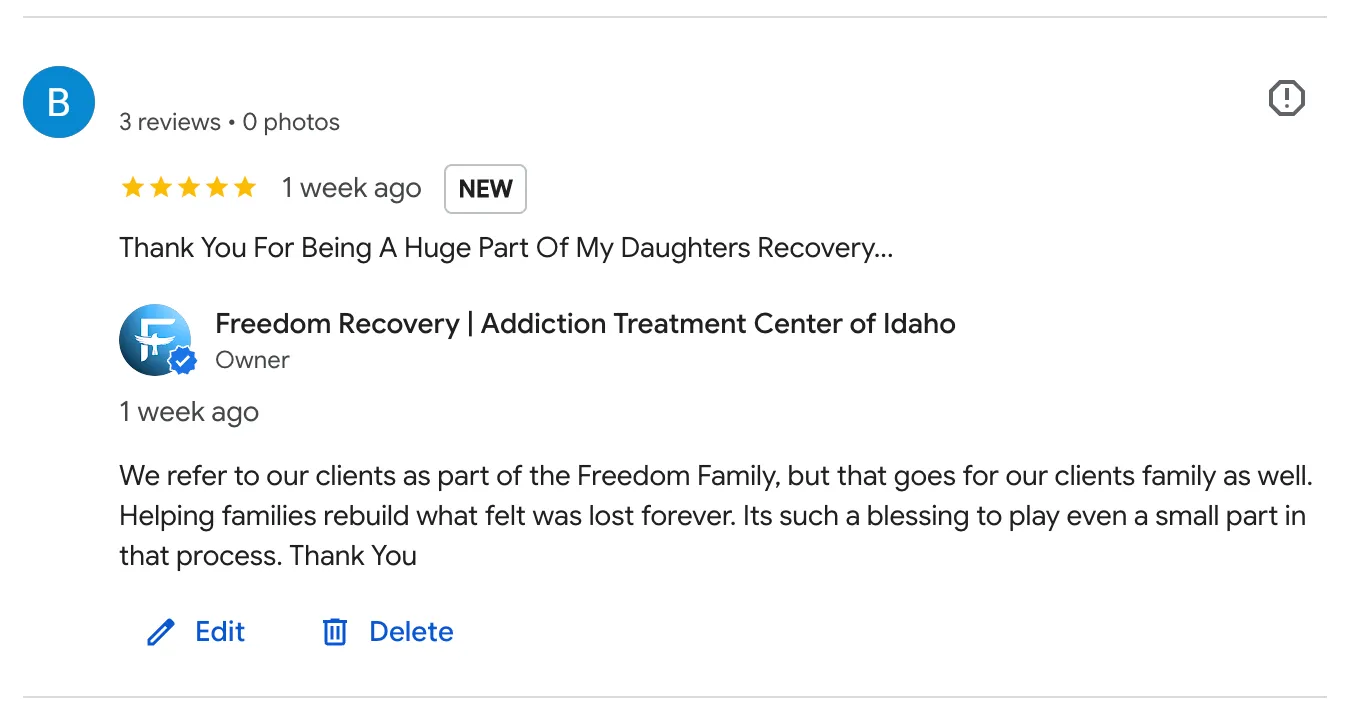
Freedom Recovery, an addiction treatment center in Idaho, is the clearest example we’ve run this on. Before working with RxMedia, their site and GBP didn’t reflect the quality of care they actually delivered: outdated design, unclear services, no consistent local optimization. After a GBP overhaul (categories, services, photos, regular posts) paired with local SEO and a rebuilt site, first-time calls rose 239% and Google Business Profile interactions doubled, with the center reaching #1 for “Addiction Treatment Idaho,” “Alcohol Rehab Idaho,” and three other core local terms within 6 to 12 months.
The fix: Treat your GBP as a living asset. Complete every field, add photos regularly, post updates, and answer every question that comes in, not just the flattering ones.
Mistake 4: Weak or missing location pages for multi-location centers
Centers running more than one facility often let a single page try to represent every location, or spin up thin location pages that are copy-paste templates with the city name swapped in. Neither works. Google treats each physical location as its own local entity that needs its own signals, and so do the AI-driven map and search results families now rely on.
The fix: Give every location its own GBP, its own dedicated page with location-specific content (staff, programs offered at that site, service area), and its own optimization plan. One page doing five jobs does none of them well.
Mistake 5: Duplicate or near-duplicate content across service and location pages
This compounds mistake 4. When location pages (or service pages for similar programs, such as IOP vs. PHP vs. outpatient) are built from the same template with minimal differentiation, search engines struggle to determine which page should rank for which query, and often suppress both.
The fix: Write each page around what’s actually distinct about that location or program (admissions criteria, specific staff, insurance accepted at that site, program length) rather than reusing boilerplate with a find-and-replace. This is where a dedicated content strategy earns its keep.
Mistake 6: Review management that’s either absent or non-compliant
Two failure modes show up equally often: centers that don’t have a system to generate reviews from real patients at all, and centers that respond to reviews in ways that risk confidentiality. You can’t acknowledge that a reviewer was ever a patient or reference any treatment detail in a public response; under 42 CFR Part 2, that’s a stricter bar than standard HIPAA practice.
The cost of getting this wrong is well documented. In BrightLocal’s 2026 Local Consumer Review Survey, 97% of consumers said they read reviews for local businesses, 92% said star ratings factor into which business they choose, and 47% said they won’t use a business with fewer than 20 reviews at all. Star rating thresholds are also climbing: 31% of consumers now say they’ll only use a business with 4.5 stars or higher, up from just 17% a year earlier. Responsiveness matters just as much: 89% of consumers expect a business to respond to their reviews, 80% say they’re more likely to use a business that responds to all of its reviews, and 50% said generic, templated responses make them unlikely to choose a business at all.
The fix: Build an ethical, consistent review management process for requesting reviews from patients who’ve completed care, and use response templates that maintain warmth and professionalism without ever confirming a treatment relationship, including for the negative reviews, which is where most centers go quiet instead of responding.
Mistake 7: Ignoring local search intent in content and keyword strategy
Content built around “addiction treatment” as a single national keyword misses how people actually search locally. Another Chance, a two-location outpatient center in Portland, had this exact problem: a site that wasn’t optimized for search, unclear program pages, and no local search strategy. After a rebuild around Portland-specific keywords, technical SEO fixes, and GBP work tied to each location, organic visitors grew 333% and first-time calls grew 242% within 12 months, landing the center at #1 for “IOP Portland” and top-3 for four other high-intent local terms.
The fix: Build keyword and content strategy around the actual local phrasing patients use (city, neighborhood, insurance-plus-location combinations, and level-of-care-plus-location combinations) rather than generic national terms.
What this looks like when a center starts from zero
Atlas Addiction Treatment launched in Oregon with no website, no GBP, and no local SEO foundation at all. Building all three from scratch, including a healthcare CRM to track every lead from that first call, drove a 2,063% increase in first-time calls and a 794% increase in GBP interactions within the first year. The mistakes above aren’t abstract; fixing them (or avoiding them from day one) is most of what separates that kind of trajectory from a center that never gets found.
Conclusion
None of these mistakes are complicated to fix; they’re just easy to let slide when the clinical side of the business is the priority. But local search is where behavioral health searches actually resolve into phone calls, and every one of the fixes above is something a center can start correcting this week.
Want to know where your center stands? Get a free local SEO audit — we’ll review your GBP, citations, and local visibility, and tell you exactly what we’d fix first.
Frequently asked
How long does it take to fix local SEO mistakes once identified?
NAP corrections and GBP field completion can happen within days. Ranking movement in the map pack typically shows up over 60 to 90 days, and the fuller gains, like the ones above, compound over 6 to 12 months.
Is Google Business Profile more important than the website for local search?
They work together, but for behavioral health specifically, GBP often drives the majority of local clicks through the map pack, which sits above organic results. A strong GBP with a weak site still loses the call; treat both as required, not either/or.
What's the single highest-leverage fix for a center that can only do one thing right now?
Correct and complete the Google Business Profile: categories, NAP consistency, complete fields, and current photos. It's the fastest fix with the most direct line to phone calls.
Do these mistakes apply the same way to a single-location center as a multi-location one?
The GBP, NAP, and review issues apply equally. Duplicate content and thin location pages are specific to multi-location centers, though single-location centers should still avoid templated, generic service pages for the same reason.
How do I know if my center is currently making these mistakes?
A local SEO audit covering GBP completeness, citation consistency, review profile, and current map-pack rankings will surface each of these directly. Book a free local SEO audit and we'll show you exactly where the gaps are.